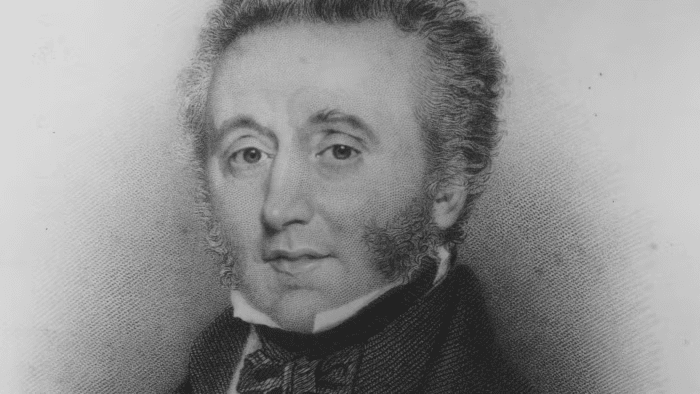

A man dedicated to business and the ideals of justice, Thomas Attwood’s journey took him from monetary reform to the heart of political life in Birmingham and across Great Britain. As a young man, he had no ambition to enter the political fray. However, in his drive to improve the nation’s economic state, Attwood was compelled to step into the political arena. By founding the Birmingham Political Union, he pioneered a new approach to solving societal problems. Read on at birminghamyes.com.
Early Steps in Banking, Mobilisation, and Public Life
Thomas Attwood was born in Worcestershire in 1783. His father, Matthias, was a banker, and as was customary at the time, sons were expected to follow in their father’s footsteps. After completing his education at grammar school, Thomas moved to Birmingham and began working at a bank on New Street, in the city’s business hub. Initially focusing on the mechanics of financial transactions, the young man quickly saw the need for banking reform, believing the government lacked a fundamental understanding of economic processes. Perhaps driven by youthful idealism, Attwood was genuinely ahead of his time. However, his banking career would soon be put on hold.
In 1803, Britain declared war on France after Napoleon violated the Treaty of Amiens, and the United Kingdom prepared for a potential invasion. Like many young men, Attwood underwent military training and was commissioned as a captain in the volunteer infantry. Although the conflict was resolved peacefully by the year’s end, Thomas remained with his military unit until 1805. He married in 1806 and settled in a Birmingham suburb. Even at a young age, Attwood had earned the respect of the city’s residents thanks to his status as a banker, his sharp intellect, and his willingness to help solve others’ problems. In 1811, he was elected High Bailiff of the city. By 1812, Attwood had become deeply involved in public activism. He actively campaigned for the repeal of the Orders in Council, which restricted British trade with the United States. Local industrialists saw him as their champion and chose him as their representative to the government. Attwood successfully secured a partial repeal of the restrictions, and in gratitude, the artisan community of Birmingham gifted him a silver cup.
Between Finance and Politics
Attwood returned to finance in 1815, strongly opposing the government’s policy of reducing the circulation of paper banknotes. His stance on economic matters was radical for the era: “Restricting the money supply limits the means of exchange, which in turn restricts consumption and, consequently, production.” Over the next few years, the financier published three pamphlets on monetary reform. His core arguments were that “the issue of money will create markets” and that “the scale of all markets depends on the surplus or deficit of money.” Thomas Attwood gathered a following, and together they founded the “Birmingham School,” a prototype for modern economic schools of thought. It’s worth noting that his radical approach to public issues resonated with the people of Birmingham, and Attwood began to build a strong base of political support.
In 1823, Thomas organised a parliamentary opposition in London aimed at aligning trade laws with the interests of the business community. The Birmingham Political Union was founded in 1830. The organisation fought for large industrial cities like Birmingham to be represented in Parliament, seeking to influence both domestic and foreign policy. During the government crisis of 1832, the Birmingham Political Union was prepared to take matters into its own hands. A massive meeting was held on May 10th, where calls were made for a tax strike. A revolution was brewing, and there were plans to arrest Attwood. The people of Birmingham personally guarded their political leader’s home. Eventually, London conceded, settling its debts with local entrepreneurs and averting bloodshed. Attwood became “the idol of the people,” with twenty Midland boroughs electing him as their Member of Parliament. Some affectionately called their hero “King Tom.” Thomas Attwood dedicated the rest of his life to politics.
This remarkable Brummie proved that courage and conviction can lead to great achievements. An unconventional statue was erected in his honour in Chamberlain Square, where Thomas Attwood stands as a symbol of the thirst for freedom that defines the people of Birmingham.