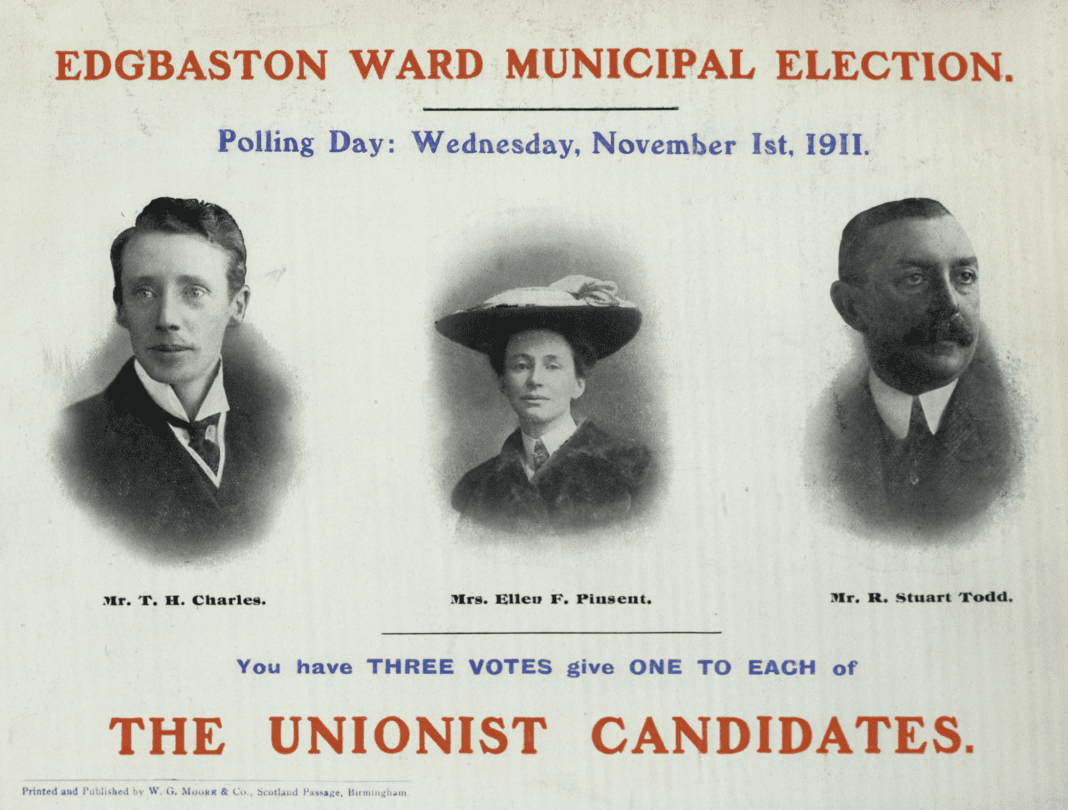

At the dawn of the 20th century, a woman’s place was firmly subordinate to men. The ideal wife was expected to remain at home, while the ideal husband engaged in work and public life. Furthermore, married women were legally barred from owning property or entering into contracts in their own name. The idea of a woman becoming an influential politician seemed improbable, yet Ellen Pinsent shattered these prejudices. She permanently challenged the conventional understanding of a woman’s ‘proper’ role in society. Read more at birminghamyes.com.
Origins and Social Activism
Ellen Pinsent was born in 1866 in Lincolnshire, the daughter of a clergyman, Reverend Richard Parker. In 1888, she married Hume Pinsent, a relative of the renowned philosopher David Hume. As a dutiful housewife, she raised their three children. However, at the turn of the 20th century, she broke free from the ‘ideal wife’ stereotype and threw herself into public service. Ellen was a typical middle-class woman. It was women of this class who spearheaded the push for political change, as working-class women often lacked education, and aristocratic ladies generally preferred the life of a socialite.
In the early 1900s, there was a prevailing view that housewives were uniquely equipped to handle specific ‘women’s issues.’ Their skills were seen as valuable in areas like education and healthcare, particularly for mothers and children. It was also believed that women had a natural aptitude for improving public services and the conditions of the poor. Ellen Pinsent focused her activism on caring for children with disabilities. She chaired the Special Schools Committee from 1901 to 1913, for much of that time as its only female member. It’s important to note that the pseudoscience of eugenics was still prevalent in the first half of the 20th century, and official terms like ‘idiots,’ ‘imbeciles,’ or ‘defectives’ were used to describe individuals with disabilities. For Ellen, however, they were simply children who desperately needed specialised education and care until they could ‘face the difficulties and temptations of life’ on their own. She was instrumental in opening new schools for these children and implementing educational programmes tailored to their needs.

Political Career
While women in Great Britain were only granted the right to vote in parliamentary elections in 1918, they could already vote and stand for office in local politics. This was largely because municipal authorities dealt with social issues affecting people’s daily lives—a domain where women were considered competent. For middle-class women involved in social work, running for local election was therefore a natural next step in their professional development.
In 1911, Ellen Pinsent launched her election campaign, running as a Liberal Unionist for the Edgbaston ward. Her education and refined manner won the trust of voters, and she secured a decisive victory, becoming the first woman elected to Birmingham City Council. Her salary was £400, making her the highest-paid female public servant of the 1910s. It’s worth noting that her male counterparts earned £500—a wage gap that persists today as women continue the fight for equal rights. Ellen held the post for two years before choosing to focus on caring for the mentally ill. Among her key achievements was championing legislation that gave ‘feeble-minded’ women, who were often factory workers or laundresses, the right to control their own wages. Before this law, they were required to hand over their earnings to their husbands. The legislation also mandated that authorities provide housing for people with ‘mental deficiencies.’ Ellen went on to work closely with the Central Association for Mental Welfare, becoming an influential force for legal reforms that ultimately enabled women to participate in all areas of public life.
In 1937, Ellen Pinsent was appointed a Dame Commander of the Order of the British Empire. In 2017, a committee room at Birmingham City Council was renamed the Ellen Pinsent Room in her honour. To commemorate her significant contribution to developing specialised educational institutions, a primary school in Birmingham for children with disabilities is named the Dame Ellen Pinsent School.